Aterosclerose – Excelente artigo de revisão sobre a progressão da placa aterosclerótica
Aterosclerose
Clique no link abaixo e leia na íntegra este excelente artigo de revisão sobre a progressão da placa aterosclerótica publicado no Heart, Lung and Circulation 2013;22:399–411.
pathophysiology-of-atherosclerosis-plaque-progression
REVIEW
Pathophysiology of Atherosclerosis Plaque Progression
Kenichi Sakakura, MD, Masataka Nakano, MD, Fumiyuki Otsuka, MD, Elena Ladich, MD, Frank D. Kolodgie, PhD and Renu Virmani, MD∗ CVPath Institute, Inc., 19 Firstfield Road, Gaithersburg, MD 20878, USA
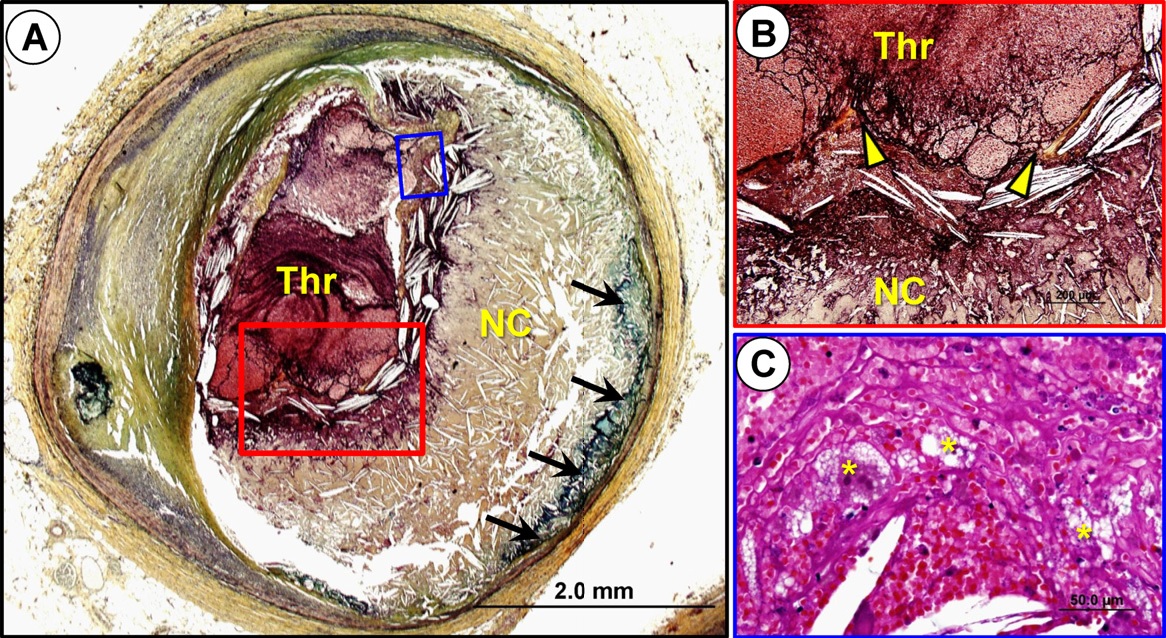
Atherosclerotic plaque rupture with luminal thrombosis is the most common mechanism responsible for the majority of acute coronary syndromes and sudden coronary death. The precursor lesion of plaque rupture is thought to be a thin cap fibroatheroma (TCFA) or “vulnerable plaque”. TCFA is characterised by a necrotic core with an overlying thin fibrous cap (≤65m) that is infiltrated by macrophages and T-lymphocytes. Intraplaque haemorrhage is a major contributor to the enlargement of the necrotic core. Haemorrhage is thought to occur from leaky vasa vasorum that invades the intima from the adventitia as the intima enlarges. The early atherosclerotic plaque progression from pathologic intimal thickening (PIT) to a fibroatheroma is thought to be the result of macrophage infiltration. PIT is characterised by the presence of lipid pools which consist of proteoglycan with lipid insudation. The conversion of the lipid pool to a necrotic core is poorly understood but is thought to occur as a result of macrophage infiltration which releases matrix metalloproteinase (MMPs) along with macrophage apoptosis that leads to the formation of a acellular necrotic core. The fibroatheroma has a thick fibrous cap that begins to thin over time through macrophage MMP release and apoptotic death of smooth muscle cells converting the fibroatheroma into a TCFA. Other causes of thrombosis include plaque erosion which is less frequent than plaque rupture but is a common cause of thrombosis in young individuals especially women <50 years of age. The underlying lesion morphology in plaque erosion consists of PIT or a thick cap fibroatheroma. Calcified nodule is the least frequent cause of thrombosis, which occurs in older individuals with heavily calcified and tortious arteries. (Heart, Lung and Circulation 2013;22:399–411) © 2013 Australian and New Zealand Society of Cardiac and Thoracic Surgeons (ANZSCTS) and the Cardiac Society of Australia and New Zealand (CSANZ). Published by Elsevier Inc. All rights reserved.
Keywords. Pathophysiology; Atherosclerosis; Plaque progression; Plaque rupture; Thin cap fibroatheroma; Remodelling
/media/blog/2016/11/Pathophysiology-of-Atherosclerosis-Plaque-Progression.pdf